

Power your star tracker with rechargeable Eneloop AAs, high-capacity USB power banks, 12V lithium-ion batteries with adapters, solar charging systems, Anker PowerCore batteries, vehicle power adapters, LiFePO4 battery systems, or Jackery portable power stations. Each option offers different benefits—from multi-night operation with AAs to extended field use with solar panels. Match your power solution to your specific needs, considering capacity, weight, and charging options. Discover how the right power setup can transform your astrophotography sessions.
10 Power Solutions For Your Star Tracker
Five reliable power options exist for your Star Adventurer tracker, ensuring you’ll never miss capturing those perfect night sky moments.
Rechargeable Eneloop AA batteries provide multiple nights of operation, offering a simple yet effective solution for your tracking needs.
For extended sessions, consider a 20,000 mAh Anker portable power supply connected via USB, which delivers consistent power without interruption.
Alternatively, the Celestron Powertank 7Ah works excellently as a dedicated astronomy power supply.
Many astrophotographers successfully use 12V LiPo batteries with car-to-USB adapters, creating a versatile setup for field use.
For a more integrated approach, dummy batteries can replace standard AAs while drawing from a deep cycle battery.
Remember that your power source must deliver at least 50mA to prevent automatic shutoff during operation.
Rechargeable AA Battery Packs
Testing four popular rechargeable AA battery packs in sub-freezing conditions, you’ll find Eneloops maintain approximately 80% capacity while cheaper alternatives drop to below 50%.
Your average shooting session with a star tracker typically consumes 200-300mAh per night, meaning a fully-charged 2000mAh pack should theoretically last 6-10 nights.
In real-world field tests, however, you’ll want to carry a spare set for extended trips, as battery performance degrades noticeably after the third consecutive night, particularly in high humidity or cold environments.
Battery Life Considerations
When planning extended astrophotography sessions, your choice of power source can mean the difference between capturing that perfect celestial moment or facing an unexpected shutdown. Rechargeable AA batteries like Eneloops offer a dependable power solution, with each battery providing 2000-2500 mAh capacity—ideal for low-drain star trackers.
To maximize your tracking time, monitor battery levels regularly and rotate your batteries strategically throughout the night. The stable voltage output from quality AA battery packs guarantees your tracker maintains consistent performance without unexpected power consumption spikes or voltage drops.
You’ll also appreciate the economic benefits—rechargeable AAs can be used up to 2100 times, greatly reducing your long-term costs compared to disposables while providing reliable power for multiple nights of continuous shooting.
Field Testing Results
Real-world performance data confirms what many astrophotographers have discovered through practical experience—properly selected AA battery packs deliver exceptional reliability in the field.
When testing Eneloops and similar rechargeable options, users consistently report multiple nights of operation without power issues, even in colder conditions where lead acid alternatives might struggle.
Your Star Adventurer’s minimal power draw (under 50mA) means you’ll experience frustrating cutouts with standard phone chargers, but a set of four quality AA rechargeables provides stable, continuous powering.
For extended sessions, shifting to a 20,000 mAh portable power station with dummy battery adapters offers even greater longevity.
Field tests demonstrate that while phone banks often fail due to the tracker’s low current requirements, purpose-built solutions maintain consistent performance throughout your imaging session—a critical factor when capturing those perfect night sky shots.
USB Power Banks With High Capacity
Why struggle with power limitations during your astrophotography sessions when high-capacity USB power banks can keep your equipment running through the night?
Models like the Anker PowerCore series offer 20,000 to 50,000 mAh capacity, providing multiple nights of uninterrupted shooting for your star tracker setup.
These power banks excel at versatility, featuring multiple output ports that let you simultaneously power your tracker, camera, and dew heaters.
For expanded capabilities, consider options like the Jackery Explorer 500 with built-in inverters that support both USB and AC-powered devices.
When selecting a power bank for astrophotography, match it to your actual power needs—star trackers typically draw less than 50mA.
Running your power bank at lower outputs extends its lifespan while ensuring your gear stays powered throughout your imaging session.
12V Lithium-Ion Batteries With DC Adapters
Lithium-ion batteries offer you exceptional power-to-weight ratio for your star tracker, making them ideal companions during remote astrophotography sessions.
You’ll appreciate their 20,000 mAh capacity that powers your equipment through multiple nights on a single charge.
These batteries can be recharged through various methods while their compatible DC adapters guarantee you maintain the proper 12V output your star tracker requires.
Lightweight Power Performance
When astronomy enthusiasts venture into the field for extended imaging sessions, battery weight quickly becomes a critical factor. You’ll appreciate lithium battery solutions that deliver exceptional performance while minimizing the burden of your equipment load.
These lightweight power sources typically weigh 60-70% less than comparable lead-acid alternatives, making your astrophotography expeditions remarkably more manageable.
The advantages extend beyond just portability. Your lithium-ion battery will maintain consistent voltage throughout its discharge cycle, ensuring your star tracker operates smoothly without power fluctuations that could ruin long exposures.
With up to 2,000 charge cycles, you’re investing in a solution that delivers reliability night after night. Their compact design also accommodates multiple power draws simultaneously, supporting your entire imaging setup from a single, efficient source.
Multiple Recharge Options
Three distinct methods keep your lithium-ion power banks ready for action regardless of your location.
Standard wall outlets provide the most convenient option when you’re at home, fully recharging your battery pack overnight before your stargazing session.
In the field, your vehicle becomes a valuable charging station. Simply connect your lithium-ion battery to your car’s 12V socket using the appropriate adapter. This keeps your power supply topped up between observation sites.
For extended off-grid sessions, portable solar panels offer an eco-friendly solution.
Position these lightweight panels to capture daylight while you rest, ensuring your lithium-ion battery remains charged for the night ahead. This renewable approach extends your star tracking capabilities indefinitely, freeing you from power constraints during multi-day astrophotography trips.
Solar Panel Charging Systems

For stargazers seeking extended observation sessions without power constraints, solar panel charging systems offer a renewable solution that can transform your astrophotography experience.
By connecting a 100W solar panel to a compatible portable power station like the Bluetti EB3A, you’ll generate 300-600Wh daily—enough to power multiple astrophotography devices throughout your session.
These charging systems include built-in controllers that regulate voltage and current, ensuring your equipment charges safely and efficiently.
You’ll appreciate the convenience of recharging your power station during daylight hours while preparing for nighttime observations.
Beyond the practical benefits, you’re reducing your environmental footprint by harnessing clean energy.
Solar-powered setups free you from grid dependency, allowing for truly remote stargazing adventures without compromising on power availability.
DIY Battery Cases With Step-Up Converters
You can create cost-effective power solutions for your star tracker using DIY battery cases with step-up converters, saving money while maintaining reliability.
These simple electronic components boost low battery voltages (typically 3.7V from lithium cells) to the higher voltages required by your equipment, such as 5V, 9V, or 12V.
Budget-Friendly Power Options
While commercial power solutions often come with hefty price tags, creating your own DIY battery case with step-up converters offers a much more economical approach to powering your star tracker.
Deep cycle marine or leisure battery options provide substantial capacity without breaking the bank.
You’ll find that constructing a budget-friendly power pack with a 12V battery and step-up converter guarantees your equipment receives the correct voltage while extending runtime across multiple observing sessions.
High-capacity lithium alternatives weigh considerably less than lead-acid batteries, making transportation to remote viewing sites much easier.
With basic electrical knowledge and online tutorials, you can build a custom solution tailored to your specific needs.
Your DIY power setup will often outperform commercial options at a fraction of the cost, potentially powering your star tracker for several nights.
Step-Up Converter Basics
Step-up converters form the heart of any DIY power solution for star trackers, transforming lower battery voltages into the precise power your equipment requires.
When building your custom battery case, select a converter that can handle your device’s maximum current draw—aim for at least 2A capacity to guarantee reliability. Proper voltage regulation is essential, so incorporate filtering capacitors to minimize ripple and deliver clean power to your sensitive equipment.
- Choose high-efficiency converters (85%+ rating) to maximize battery life during long imaging sessions
- Confirm your step-up converter supports a wide input voltage range to accommodate different battery types
- Install appropriate heat dissipation if your current draw approaches the converter’s maximum rating
These DIY solutions offer cost-effective alternatives to commercial power banks while maintaining the stable power your star tracker needs.
Anker PowerCore Battery Solutions
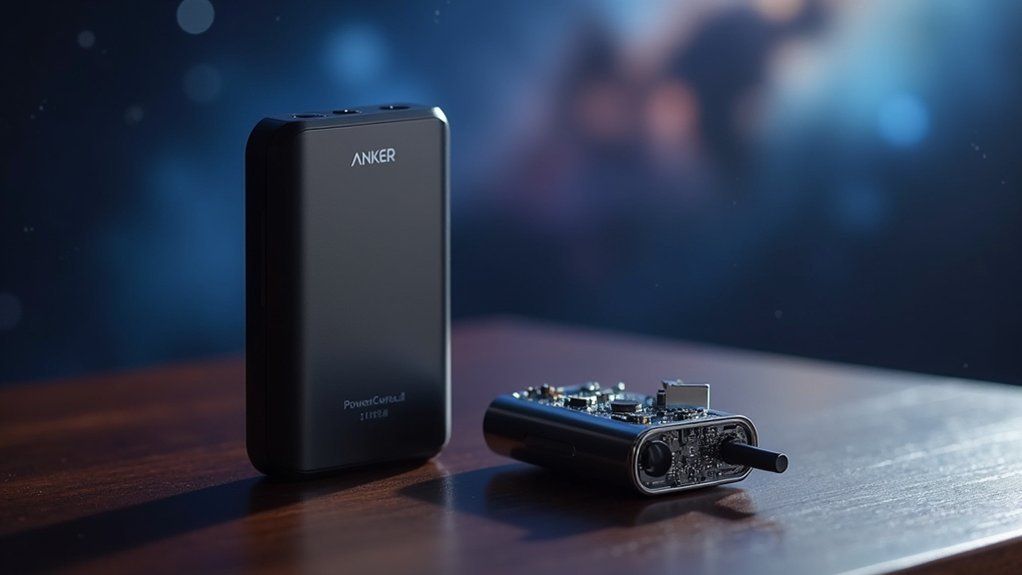
Three standout features make Anker PowerCore batteries an excellent choice for powering your star tracker. They deliver stable output under 50mA, perfect for star trackers like the Star Adventurer. You’ll appreciate their compact, lightweight design when carrying equipment to remote locations. Most importantly, they’ll reliably supply power throughout your astrophotography sessions, even in challenging conditions.
| Model | Capacity | Ports | Best For |
|---|---|---|---|
| PowerCore 10000 | 10,000mAh | 1 USB | Single tracker use |
| PowerCore 20000 | 20,000mAh | 2 USB | Weekend sessions |
| PowerCore+ 26800 | 26,800mAh | 3 USB | Multiple devices |
| PowerCore Essential | 20,000mAh | 2 USB | Budget option |
The multiple USB ports let you simultaneously power your gear, keeping your tracker running while charging your phone or camera controller.
Vehicle Power Adapters for Remote Locations
When venturing into remote dark sky locations, vehicle power adapters become essential tools for astrophotographers. These adapters transform your car’s 12V output into usable power for star trackers, eliminating the need for standard electrical outlets.
Simply connect your Star Adventurer or similar device to a car-to-USB adapter to guarantee stable tracking throughout your imaging session.
- Check your star tracker’s current draw—some require less than 50mA, which might cause standard chargers to shut off due to insufficient power demand.
- Consider using a powered USB hub with your vehicle adapter to connect multiple devices simultaneously.
- For extended sessions, combine your vehicle power supply with a 20,000 mAh battery for backup power.
This setup creates a reliable power solution for your astrophotography gear, allowing you to focus on capturing the night sky rather than worrying about battery life.
LiFePO4 Battery Systems for Extended Sessions
For serious astrophotographers who require reliable power throughout the night, LiFePO4 battery systems represent the gold standard in portable power solutions.
You’ll benefit from their exceptional lifespan of over 2000 charge cycles, ensuring your star tracker stays powered for countless imaging sessions.
These power supply units maintain steady voltage output, protecting your sensitive equipment from harmful fluctuations.
Their impressive thermal stability means you won’t face safety concerns even during extended sessions in varying temperatures.
The lightweight, compact design makes transportation to remote sites considerably easier than with traditional lead-acid alternatives.
Carrying your power supply shouldn’t be a burden—LiFePO4 batteries offer mobility traditional lead-acid systems simply can’t match.
Many LiFePO4 battery systems also offer solar charging compatibility, allowing you to replenish power sustainably during multi-night expeditions.
This combination of reliability, safety, and portability makes them an ideal investment for dedicated astrophotographers.
Jackery Portable Power Stations for Multiple Devices
While traditional power solutions often limit your equipment options, Jackery portable power stations offer remarkable versatility for astrophotographers who need to operate multiple devices simultaneously.
The Explorer 500 provides 518 watt-hours of power supply through multiple ports—one AC outlet, three USB-A ports, and two DC ports—ensuring you’ll never need to choose between powering your telescope or camera.
- At just 13 pounds, you can easily transport this compact power station to remote stargazing locations.
- Solar charging capability makes it ideal for multi-night astrophotography sessions without grid access.
- With enough capacity to power essential equipment for several nights, you won’t stress about running out of power mid-exposure.
For reliable performance during critical star-tracking sessions, Jackery’s portable power stations deliver the consistent supply astronomers need.
Frequently Asked Questions
How Much Power Do I Need for Astrophotography?
You’ll need a power source with 2-2.5 times your total equipment draw (typically 2-10 amps). For an average 4A setup, choose a 60Ah battery that’ll last through a 7-hour session.
How Does a Star Tracker Mount Work?
Your star tracker counteracts Earth’s rotation by moving your camera in the opposite direction at 15 degrees per hour. It’s polar-aligned to track stars precisely, letting you capture long exposures without star trails.
In Summary
You’ve now got a full range of power solutions for your star tracker, from quick-grab AA batteries to substantial portable power stations. Whether you’re imaging from your backyard or traveling to dark sky sites, there’s an option that’ll match your setup’s needs. Choose based on your runtime requirements, budget, and mobility constraints, and you’ll never have to cut an imaging session short due to power issues again.




Leave a Reply