You’re looking to capture crisp planetary details, but you’ve realized your current setup isn’t quite cutting it. A quality Barlow lens can transform your astrophotography results, yet choosing the right one isn’t straightforward. With magnifications ranging from 2x to 5x and competing optical designs, you’ll need to understand what separates the performers from the rest.
| SVBONY SV216 3X Barlow Lens Telescope Accessory | 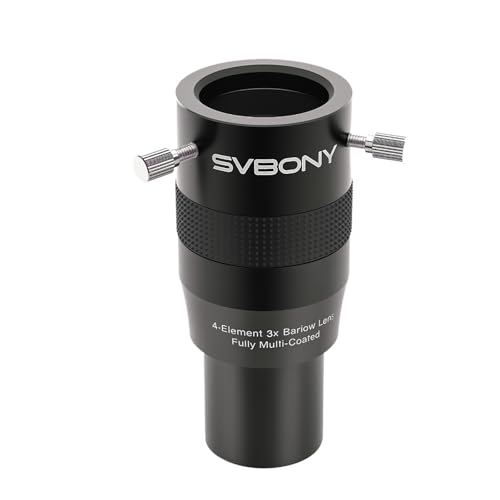 | Premium APO Design | Magnification Power: 3x magnification | Barrel Size: 1.25 inch | Optical Elements: 4-element APO fully multi-coated | CHECK ON AMAZON | Read Our Analysis |
| Celestron 93326 Omni Barlow Lens Silver 2 x 1.25 Inch |  | Best Value | Magnification Power: 2x magnification | Barrel Size: 1.25 inch | Optical Elements: 2-element fully multi-coated | CHECK ON AMAZON | Read Our Analysis |
| SVBONY 5X Telescope Barlow Lens 1.25 Inch |  | High Magnification Power | Magnification Power: 5x magnification | Barrel Size: 1.25 inch | Optical Elements: 3-element 2-group fully multi-coated | CHECK ON AMAZON | Read Our Analysis |
| Astromania 5X Barlow Lens Telescope Accessory |  | Professional Grade | Magnification Power: 5x magnification | Barrel Size: 1.25 inch | Optical Elements: 4-element multi-coated | CHECK ON AMAZON | Read Our Analysis |
| SVBONY SV216 2X Barlow Lens Telescope Accessory |  | Optical Excellence | Magnification Power: 2x magnification | Barrel Size: 1.25 inch | Optical Elements: 4-element APO fully multi-coated | CHECK ON AMAZON | Read Our Analysis |
| SVBONY 2X Barlow Lens with M42 Thread |  | Astrophotography Specialist | Magnification Power: 2x magnification | Barrel Size: 1.25 inch with M42 thread | Optical Elements: 2-element 1-group multi-coated | CHECK ON AMAZON | Read Our Analysis |
| 1.25-inch 5X Barlow Lens & Moon Filter Kit-for Telescope Eyepieces |  | Complete Kit Solution | Magnification Power: 5x magnification (2.5x practical) | Barrel Size: 1.25 inch with M42 thread | Optical Elements: 5x Barlow (element count not specified) | CHECK ON AMAZON | Read Our Analysis |
More Details on Our Top Picks
SVBONY SV216 3X Barlow Lens Telescope Accessory
If you’re serious about planetary astrophotography, the SVBONY SV216 offers a straightforward way to boost magnification without sacrificing optical quality. This 1.25-inch 3x Barlow lens features four fully multi-coated elements that maximize light transmission while minimizing distortion. The apochromatic optical design delivers sharp, detailed views of celestial objects. You’ll appreciate the durable aluminum housing with its three-screw coaxial locking mechanism, which maintains precise alignment and stability. Black-coated lens edges reduce halos and reflections for crisper images. The brass compression ring resists deformation, ensuring long-term reliability. Combined with low-power eyepieces, you’ll achieve enhanced magnification while maintaining a comfortable exit pupil for extended observing sessions.
- Magnification Power:3x magnification
- Barrel Size:1.25 inch
- Optical Elements:4-element APO fully multi-coated
- Housing Material:Aluminum with brass compression ring
- Weight:5.7 ounces
- Additional Accessories Included:Dust cap and end cap
- Additional Feature:APO apochromatic optical quality
- Additional Feature:3-screw coaxial locking mechanism
- Additional Feature:Edge-coated lens halos reduction
Celestron 93326 Omni Barlow Lens Silver 2 x 1.25 Inch
The Celestron 93326 Omni Barlow Lens stands out for observers seeking straightforward magnification enhancement without compromising optical quality. You’ll appreciate its fully multi-coated two-element optics that deliver bright, high-contrast views ideal for planetary imaging. The precision-machined 1.25″ barrel fits securely in your focuser while accepting standard eyepieces. Its 2x magnification effectively doubles your eyepiece power—transforming a 25mm lens into a 12.5mm equivalent. You’ll benefit from increased eye relief, making extended viewing sessions more comfortable, especially if you wear glasses. The blackened edges minimize internal reflections, preserving image clarity. Though discontinued, this reliable Barlow remains a practical choice for astrophotographers wanting dependable performance without unnecessary complexity.
- Magnification Power:2x magnification
- Barrel Size:1.25 inch
- Optical Elements:2-element fully multi-coated
- Housing Material:Precision-machined metal barrel
- Weight:2.82 ounces
- Additional Accessories Included:Metal thumbscrew lock
- Additional Feature:Doubles eye relief comfort
- Additional Feature:Precision-machined barrel design
- Additional Feature:Metal thumbscrew eyepiece lock
SVBONY 5X Telescope Barlow Lens 1.25 Inch
For astrophotographers seeking to maximize magnification without replacing their entire eyepiece collection, SVBONY’s 5X Barlow Lens delivers exceptional value. Its fully multi-coated, 3-element optical design produces crisp, sharp visuals ideal for planetary observation. The black anodized aluminum housing minimizes glare and enhances contrast during viewing sessions. You’ll appreciate the compact 1.25-inch construction that integrates seamlessly with standard eyepieces. While discontinued by the manufacturer, this model remains a budget-friendly option for observers wanting to extend their magnification range without significant investment.
- Magnification Power:5x magnification
- Barrel Size:1.25 inch
- Optical Elements:3-element 2-group fully multi-coated
- Housing Material:Black anodized aluminum
- Weight:4.8 ounces
- Additional Accessories Included:No accessories listed
- Additional Feature:Broadband green film coating
- Additional Feature:Black anodized contrast maximization
- Additional Feature:Short aluminum body construction
Astromania 5X Barlow Lens Telescope Accessory
Looking to amplify your planetary observations without breaking the bank? The Astromania 5X Barlow Lens delivers exceptional value for planetary astrophotography. Its 4-element multi-coated optics sharpen images while minimizing chromatic aberration, preserving true colors in low-light conditions. You’ll appreciate the universal 1.25-inch barrel design that fits most telescopes and eyepieces seamlessly. The threaded barrel accommodates filters for specialized planetary and nebula photography. Built from precision-machined aluminum alloy with black anodized finish, this Barlow withstands various environments. It includes a dust cap and protective box, ensuring your investment stays protected during storage and transport.
- Magnification Power:5x magnification
- Barrel Size:1.25 inch
- Optical Elements:4-element multi-coated
- Housing Material:Aluminum alloy with black anodized finish
- Weight:Weight not specified
- Additional Accessories Included:Dust cap
- Additional Feature:Chromatic aberration reduction technology
- Additional Feature:CNC precision-machined construction
- Additional Feature:Threaded barrel filter compatibility
SVBONY SV216 2X Barlow Lens Telescope Accessory
If you’re serious about planetary astrophotography without sacrificing optical quality, SVBONY’s SV216 2X Barlow delivers exactly what you need. This 4-element APO design maintains constant 2x magnification while eliminating chromatic aberration and vignetting that plague standard Barlows. You’ll appreciate the telecentric optical path, which provides superior spherical aberration control and a flatter field of view. The fully multi-coated lenses and blackened edges maximize contrast by reducing internal scattering. Its 1.25-inch interface fits your existing eyepieces seamlessly, while the brass compression ring and 3-screw locking device ensure rock-solid concentricity. Whether you’re using low or high magnification eyepieces, you’ll maintain comfortable eye relief throughout your imaging sessions.
- Magnification Power:2x magnification
- Barrel Size:1.25 inch
- Optical Elements:4-element APO fully multi-coated
- Housing Material:Aluminum with brass compression ring
- Weight:13.1 ounces
- Additional Accessories Included:No accessories listed
- Additional Feature:Telecentric 4-piece design extension
- Additional Feature:Flatter field of view
- Additional Feature:Brass compression ring security
SVBONY 2X Barlow Lens with M42 Thread
The SVBONY 2X Barlow Lens delivers doubled magnification through a compact, multi-coated optical design—making it an ideal choice when you’re ready to push beyond your eyepiece collection’s current limits. You’ll appreciate the two-element, single-group broadband green film coating that sharpens planetary details while minimizing chromatic aberration. The blackened aluminum housing maximizes contrast, ensuring you capture crisp lunar and planetary features. Its M42x0.75mm thread connects seamlessly to your telescope and works as a T-adapter for DSLR/SLR photography with a separate ring. Weighing just 4.9 ounces, this precision instrument expands your observational capabilities without bulk.
- Magnification Power:2x magnification
- Barrel Size:1.25 inch with M42 thread
- Optical Elements:2-element 1-group multi-coated
- Housing Material:Black anodized aluminum
- Weight:4.9 ounces
- Additional Accessories Included:No accessories listed
- Additional Feature:M42 thread T-adapter compatibility
- Additional Feature:DSLR/SLR camera connectivity option
- Additional Feature:Broadband green film coating
1.25-inch 5X Barlow Lens & Moon Filter Kit-for Telescope Eyepieces
Want to maximize your planetary observation without investing in multiple eyepieces? This 1.25-inch 5X Barlow Lens & Moon Filter Kit delivers the magnification boost you need. The Barlow provides 2.5x magnification enhancement, effectively doubling your eyepiece’s power for crisp planetary detail. You’ll appreciate the precision CNC-processed optics and anti-rust construction designed for durability. The included Moon filter reduces glare during lunar observation, sharpening contrast and detail. Compatible with Celestron, Skywatcher, Meade, Orion, and most telescopes via universal M42 threading, this kit integrates seamlessly into your setup. For astrophotography, connect it through a T-ring to your SLR camera, then telescope. It’s an indispensable tool for serious planetary observers.
- Magnification Power:5x magnification (2.5x practical)
- Barrel Size:1.25 inch with M42 thread
- Optical Elements:5x Barlow (element count not specified)
- Housing Material:CNC-processed precision construction
- Weight:Weight not specified
- Additional Accessories Included:Moon filter included
- Additional Feature:Integrated Moon filter included
- Additional Feature:Universal M42 thread connection
- Additional Feature:Anti-rust surface treatment durability
Factors to Consider When Choosing a Barlow Lens for Magnifying Planetary Astrophotography Details
When you’re selecting a Barlow lens for planetary astrophotography, you’ll want to evaluate the magnification power that matches your telescope and atmospheric conditions, since too much magnification can degrade image quality. You should also examine the optical coating quality and chromatic aberration control, as these factors directly impact contrast and color accuracy when imaging Jupiter, Saturn, and other planets. Finally, you’ll need to verify that the barrel size’s compatible with your eyepieces and confirm the mechanical construction’s durable enough to withstand repeated use and temperature fluctuations.
Magnification Power Requirements
How do you know which magnification level will actually improve your planetary images? You’ll need to match your Barlow’s magnification factor to your telescope’s aperture and atmospheric conditions. A 2x Barlow works well for most setups, while 3x or 5x versions demand larger apertures and stable skies to maintain image brightness.
Consider your exit pupil carefully. Higher magnification reduces it remarkably, requiring darker skies or larger telescopes to prevent dimming. For planetary work, you’ll want sufficient magnification to resolve surface details without exceeding what your equipment can handle.
Test different combinations before committing to expensive equipment. Your ideal magnification depends on your specific telescope, camera, and local observing conditions, not generic recommendations.
Optical Coating Quality
What separates a crisp planetary image from a washed-out one often comes down to optical coatings. You’ll want fully multi-coated (FMC) optics that minimize light loss and maximize contrast by reducing reflections across all surfaces. Blackened lens edges and housing interiors eliminate internal reflections that create halo artifacts, sharpening edge definition where planetary details matter most.
Look for APO or apochromatic-class designs that correct chromatic aberration, preserving true color reproduction. Multi-element designs—typically three to four elements—work alongside coatings to correct aberrations and maintain sharpness across your entire field of view.
These coating and edge treatments directly impact throughput and contrast, ultimately determining whether you’ll resolve fine planetary features or lose them in optical degradation.
Barrel Size Compatibility
Beyond optical quality, you’ll need to guarantee your Barlow lens physically fits your telescope setup. The barrel size must match your telescope’s focuser and eyepiece interfaces, with 1.25 inches being the standard for most amateur astronomers. A 1.25″ Barlow works seamlessly with typical 1.25″ eyepieces, focusers, filters, and zenith mirrors without requiring adapters.
However, if you’re working with larger format equipment, you’ll want a 2″ Barlow instead. Some advanced 2x or 5x Barlows feature 1.25″ barrels with M42 internal threading for specialized connections, offering additional flexibility.
When using adapters like M42 or T-ring connections, ensure mechanical alignment remains coaxial. Misalignment causes image distortion, degrading your planetary observations. Verify compatibility before purchasing to avoid optical and mechanical complications.
Mechanical Construction Durability
The backbone of any reliable Barlow lens lies in its construction materials and assembly precision. You’ll want a sturdy aluminum housing with black anodized finish that resists wear and reduces reflections during extended field sessions. A brass compression ring secures your eyepiece without marring it, while maintaining consistent coaxial alignment for stable imaging.
Look for a 3-screw coaxial locking mechanism that provides multiple contact points, clamping your eyepiece firmly to minimize slippage during high-magnification viewing. CNC-machined construction and precision tolerances ensure tight fits with standard 1.25-inch interfaces, reducing play and optical misalignment. Don’t overlook the included dust caps and end caps—they preserve interior optics and mechanical integrity between observing sessions, extending your Barlow’s lifespan considerably.
Chromatic Aberration Control
Color fringing can severely compromise your planetary images, but you’ll find that four- or multi-element Barlow designs with APO or fully multi-coated optics effectively minimize chromatic aberration across the expanded focal range. Four-element APO configurations with edge-coated lenses specifically reduce chromatic dispersion while preserving true color reproduction during observation.
You’ll also benefit from proper coatings that lower internal reflections, which otherwise exacerbate chromatic artifacts in high-contrast planetary views. Fixed magnification designs maintain consistent chromatic performance regardless of eyepiece placement, offering predictable results.
Mechanical stability matters too—coaxial locking, brass compression rings, and precise 1.25″ interfaces ensure proper alignment, indirectly reducing chromatic artifacts caused by misalignment. When selecting your Barlow, prioritize these optical and mechanical features for superior color fidelity.
Eye Relief Considerations
While optical coatings and mechanical precision keep your planetary images sharp and color-accurate, you’ll also want to contemplate how comfortably you can actually view through the eyepiece for extended observing sessions. Eye relief becomes critical when you’re wearing glasses or observing for hours at a time.
A quality Barlow should maintain adequate eye relief rather than compress it, allowing you to position your eye naturally without pressing uncomfortably close to the lens. When pairing a Barlow with low-power eyepieces for planetary work, verify the combined eye relief accommodates your pupil size and glasses. Well-designed 1.25-inch Barlows with extended housing minimize vignetting while preserving comfortable viewing angles, ensuring your observing sessions remain productive and pain-free.
Field Of View Flatness
How consistently sharp is your planetary image from dead center to the very edges? Field of view flatness determines this critical performance metric. You’ll want a Barlow with four or five optical elements that minimize field curvature and distortion, maintaining sharpness across your entire frame. APO-designed Barlows excel at reducing chromatic aberration uniformly across the field, preserving those delicate planetary details. Edge-blackened coatings and precise coaxial alignment further enhance flatness by eliminating internal reflections that degrade peripheral image quality. High transmission combined with low distortion ensures your exit pupil remains consistent, supporting uniform focus throughout. When you prioritize field of view flatness, you’re investing in planetary images that maintain crisp detail from center to edge—essential for serious astrophotography.
Frequently Asked Questions
How Do Barlow Lenses Affect Image Quality and Contrast When Observing Planetary Details?
You’ll notice Barlow lenses magnify planetary details effectively, but they can reduce contrast slightly due to additional glass elements. You’re trading some light transmission for higher magnification, which demands excellent atmospheric conditions and quality optics for optimal results.
Can I Use a Barlow Lens With All Telescope Types, or Are There Compatibility Limitations?
You can’t use Barlows with all telescopes. You’ll face compatibility issues with fast focal ratios, short tubes, and certain mirror designs. You’ll need adequate back-focus distance and proper optical alignment for optimal results.
What Is the Difference Between Glass Quality in Budget Versus Premium Barlow Lenses?
You’ll find premium Barlow lenses use superior optical glass with better coatings, reducing chromatic aberration and light loss. Budget models contain lower-grade glass that causes more internal reflections and color fringing, noticeably degrading your planetary images.
How Do Atmospheric Conditions Impact the Effectiveness of Barlow Lens Magnification for Planets?
You’ll find that atmospheric turbulence notably reduces your barlow lens’s magnification benefits. Poor seeing conditions amplify optical aberrations, making higher magnifications counterproductive. You’re better off using lower magnifications when atmospheric stability’s compromised.
Should I Invest in a Motorized Focuser When Using High-Magnification Barlow Lenses?
You’ll absolutely benefit from a motorized focuser with high-magnification Barlow lenses. You’ll achieve sharper images since you won’t introduce vibrations through manual focusing. You’ll maintain precise focus during extended planetary observation sessions more easily.