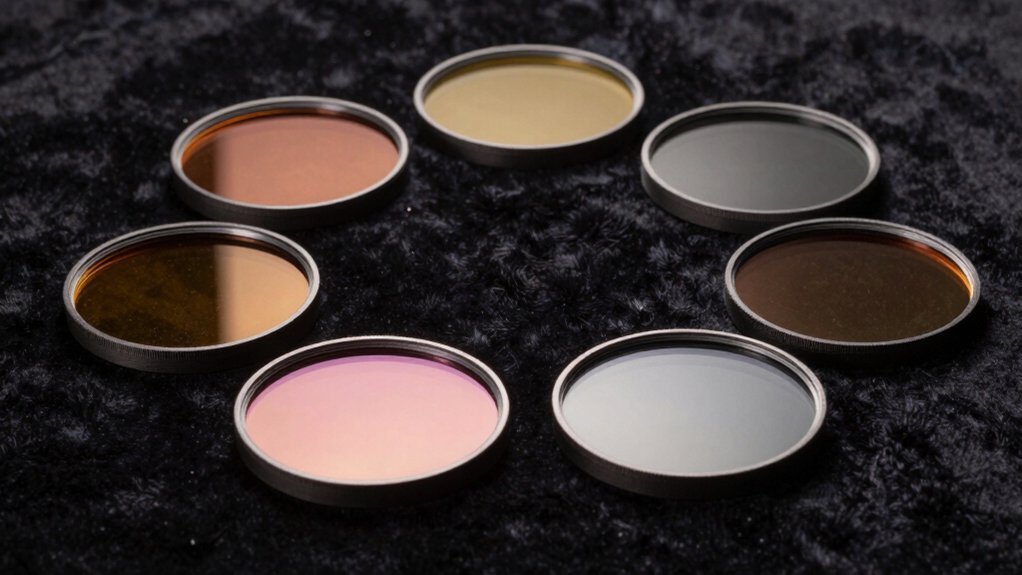
You’ve probably noticed how bright moonlight washes out lunar details through your telescope, making craters and features frustratingly difficult to observe. The right filter can transform your viewing experience by controlling glare and enhancing contrast. But with options ranging from neutral density to polarizing filters, and various thread sizes to consider, you’ll want to understand which solutions actually deliver the results you’re seeking.
| Celestron 1.25 inch Moon Filter for Lunar Observation |  | Classic & Reliable | Filter Type: Single lunar/planetary filter | Barrel Size: 1.25 inch | Light Reduction Capability: Reduces glare and increases contrast | CHECK ON AMAZON | Read Our Analysis |
| Moon Filter for Telescope 1.25 Inch ND Kit |  | Best Value Kit | Filter Type: Neutral density filter kit (ND4, ND8, ND16, ND32) | Barrel Size: 1.25 inch | Light Reduction Capability: ND4/ND8/ND16/ND32 (25%-3.125% transmission) | CHECK ON AMAZON | Read Our Analysis |
| SVBONY SV128 2″ Moon Filter Telescope Accessory |  | Premium Variable Control | Filter Type: Variable polarizing filter | Barrel Size: 2 inch | Light Reduction Capability: 1%-40% variable transmission | CHECK ON AMAZON | Read Our Analysis |
| 1.25″ Neutral Density Filter Set for Telescopes |  | Best Performance Kit | Filter Type: Neutral density filter kit (ND4, ND8, ND16, ND32) | Barrel Size: 1.25 inch | Light Reduction Capability: ND4/ND8/ND16/ND32 (75% glare reduction) | CHECK ON AMAZON | Read Our Analysis |
| 1.25″ Moon Filter for Telescope ND96 Neutral Density |  | Single Filter Solution | Filter Type: Single neutral density filter (ND96) | Barrel Size: 1.25 inch | Light Reduction Capability: ND96 (13% transmission, 87% light blocked) | CHECK ON AMAZON | Read Our Analysis |
| SVBONY 2″ Telescope Moon Filter for Lunar Observation |  | Best For 2″ Telescopes | Filter Type: Single lunar/planetary filter | Barrel Size: 2 inch | Light Reduction Capability: Mild darkening, selective wavelength filtration | CHECK ON AMAZON | Read Our Analysis |
| Neewer Telescope Moon Filter Set with 5 Color Filters |  | Most Versatile Set | Filter Type: Multi-filter set (lunar, CPL, 5 color filters) | Barrel Size: 1.25 inch | Light Reduction Capability: Glare reduction plus color-specific filtration | CHECK ON AMAZON | Read Our Analysis |
More Details on Our Top Picks
Celestron 1.25 inch Moon Filter for Lunar Observation
Why does lunar observation often leave your eyes fatigued and the Moon’s details washed out? The Celestron 1.25 inch Moon Filter solves this problem by reducing glare and enhancing contrast, making faint lunar details pop. You’ll experience more comfortable viewing with noticeably less eye strain. This black filter threads effortlessly onto most 1.25″ eyepieces in seconds, and you can stack it with other filters for customized observation. It’s equally effective for bright planets and terrestrial viewing over reflective surfaces like sand or snow. Backed by Celestron’s 2-year warranty and US-based expert support, you’re investing in a reliable tool from a California telescope leader since 1960.
- Filter Type:Single lunar/planetary filter
- Barrel Size:1.25 inch
- Light Reduction Capability:Reduces glare and increases contrast
- Frame Material:Black metal construction
- Stackable/Combinable:Yes, compatible with other 1.25″ filters
- Optical Glass Quality:Standard optical glass
- Additional Feature:Reduces eye fatigue significantly
- Additional Feature:2-Year US Warranty included
- Additional Feature:Terrestrial viewing capability
Moon Filter for Telescope 1.25 Inch ND Kit
If you’re observing the moon through a 1.25″ telescope eyepiece and struggling with glare that washes out lunar details, this neutral density filter kit offers four graduated options—ND4, ND8, ND16, and ND32—so you can dial in the perfect light reduction for your viewing conditions. The aluminum alloy frame houses precision-ground optical glass that enhances crater definition while improving contrast. You’ll appreciate the stackable design, which lets you combine filters for even greater light reduction. With M28.5 x 0.6 mm threads, it’s compatible with standard 1.25″ eyepieces and cameras. At just 1.76 ounces, it’s lightweight and durable. The 4.6-star rating from 25 reviews confirms its effectiveness.
- Filter Type:Neutral density filter kit (ND4, ND8, ND16, ND32)
- Barrel Size:1.25 inch
- Light Reduction Capability:ND4/ND8/ND16/ND32 (25%-3.125% transmission)
- Frame Material:Aluminum alloy frame
- Stackable/Combinable:Yes, filters can connect in series
- Optical Glass Quality:High-permeability precision ground optical glass
- Additional Feature:Four neutral density options
- Additional Feature:Circular polarizing technology
- Additional Feature:Sky appears bluer effect
SVBONY SV128 2″ Moon Filter Telescope Accessory
Looking for precise brightness control without sacrificing image quality? The SVBONY SV128 2″ Moon Filter delivers exactly that. This variable polarizing filter features two rotating glass elements, letting you adjust brightness from 1% to 40% transmittance. You’ll eliminate lunar glare and reflections while enhancing contrast and saturation for sharper, clearer views. The M48×0.75 threaded interface fits most standard telescopes. Built with multi-coated optical glass housed in an anodized aluminum frame, it’s durable and lightweight at just 28g. Whether you’re observing the moon or planets, this accessory prevents overexposure and gives you complete control over light levels.
- Filter Type:Variable polarizing filter
- Barrel Size:2 inch
- Light Reduction Capability:1%-40% variable transmission
- Frame Material:Anodized aluminum frame
- Stackable/Combinable:No stacking capability mentioned
- Optical Glass Quality:Multi-coating optical glass
- Additional Feature:Variable polarizing dual filters
- Additional Feature:1% to 40% transmission
- Additional Feature:Rotatable brightness adjustment
1.25″ Neutral Density Filter Set for Telescopes
Serious lunar photographers who demand precision control over exposure will appreciate this 1.25″ Neutral Density Filter Set’s four-stage light reduction system. You’ll reduce glare by 75% while revealing 200% more crater textures than basic filters. The anti-reflective coating boosts contrast by 45%, letting you capture fine details like Crisium Basin rilles during full moon phases with minimal color shift. These lightweight aluminum frames stack securely without vignetting, and you can combine filters for custom density levels. Installation takes just five seconds without tools, and the filters work universally with 1.25-inch eyepieces and cameras. You’re covered by a one-year scratch warranty.
- Filter Type:Neutral density filter kit (ND4, ND8, ND16, ND32)
- Barrel Size:1.25 inch
- Light Reduction Capability:ND4/ND8/ND16/ND32 (75% glare reduction)
- Frame Material:Hard-anodized aluminum alloy
- Stackable/Combinable:Yes, zero-vignette stacking supported
- Optical Glass Quality:Anti-reflective coated optical glass
- Additional Feature:Reveals 200% crater textures
- Additional Feature:Zero-vignette stacking capability
- Additional Feature:5-second tool-free installation
1.25″ Moon Filter for Telescope ND96 Neutral Density
Do you’ve a larger telescope with 2-inch eyepieces that demands serious lunar observation? The 1.25″ Moon Filter ND96 delivers exceptional performance for lunar viewing. This neutral density filter blocks 87% of moonlight, eliminating glare while preserving natural color and enhancing crater details. The optical glass construction ensures sharp, clear images without distortion. Its durable aluminum frame provides a secure, lightweight fit that screws easily into standard 1.25-inch eyepieces. Weighing just 0.5 ounces, it won’t strain your telescope. With 4.5 stars from 42 reviews and a #33 Best Sellers ranking in telescope filters, users consistently praise its effectiveness. Whether you’re observing lunar features or bright celestial objects, this filter transforms your viewing experience.
- Filter Type:Single neutral density filter (ND96)
- Barrel Size:1.25 inch
- Light Reduction Capability:ND96 (13% transmission, 87% light blocked)
- Frame Material:Aluminum frame
- Stackable/Combinable:No stacking capability mentioned
- Optical Glass Quality:Clear optical glass
- Additional Feature:Blocks 87% light
- Additional Feature:Preserves true natural color
- Additional Feature:Lightweight durable aluminum frame
SVBONY 2″ Telescope Moon Filter for Lunar Observation
The SVBONY 2″ Telescope Moon Filter excels for observers battling light pollution and lunar glare. This metal-framed optical glass filter reduces street lighting interference while mildly darkening your sky background, enhancing lunar surface contrast. You’ll appreciate its broad-spectrum transmission that doesn’t over-darken your view, allowing finer details to emerge against space. The 2″ standard threads fit most telescope eyepieces and let you stack additional filters. At just 1.44 ounces, it’s portable and durable. The anodized housing protects the quality optics, while the included plastic box keeps everything safe. For Moon and planetary observation, you’re getting reliable performance without unnecessary bulk.
- Filter Type:Single lunar/planetary filter
- Barrel Size:2 inch
- Light Reduction Capability:Mild darkening, selective wavelength filtration
- Frame Material:Anodized metal frame
- Stackable/Combinable:Yes, standard 2″ threads allow stacking
- Optical Glass Quality:Optical glass construction
- Additional Feature:Filters street lighting wavelengths
- Additional Feature:Mild sky background darkening
- Additional Feature:Includes plastic protective box
Neewer Telescope Moon Filter Set with 5 Color Filters
Looking for a versatile, affordable filter system that’ll tackle lunar glare while giving you flexibility for planetary observation? The Neewer set delivers exactly that. You’ll get a lunar filter that reduces glare and boosts contrast, plus a CPL filter for sharper planetary detail. The five color filters—red, orange, yellow, green, and blue—each serve specific purposes: yellow brings out Mars’s polar caps, green enhances surface features, and blue helps split binary stars. All filters feature the standard 1.25-inch thread size, fitting most telescopes. At just 4.4 ounces, this complete kit offers serious value for serious observers.
- Filter Type:Multi-filter set (lunar, CPL, 5 color filters)
- Barrel Size:1.25 inch
- Light Reduction Capability:Glare reduction plus color-specific filtration
- Frame Material:Standard construction (material not specified)
- Stackable/Combinable:Yes, multiple filters included in set
- Optical Glass Quality:Standard optical glass construction
- Additional Feature:Five color filters included
- Additional Feature:CPL reflection reduction filter
- Additional Feature:Lunar & Starglow filter
Factors to Consider When Choosing a Moon Filter for Reducing Lunar Glare During Photography
When you’re selecting a moon filter, you’ll want to evaluate several key characteristics that directly impact your lunar photography results. Consider the light transmission rates, optical glass quality, filter thread compatibility, and whether you’d prefer polarizing or neutral density options for your specific setup. You should also assess stacking capability features if you plan to combine multiple filters for enhanced glare reduction.
Light Transmission Rates
Why does one moon filter dim the lunar surface while another preserves bright details? The answer lies in light transmission rates. You’ll find that filters offer various transmission percentages—typically ranging from 1% to 40%—which directly control how much brightness reaches your camera or eye.
Lower transmission rates (around 13%) minimize glare effectively, but you risk losing fine detail in shadowed regions. Higher transmission preserves brighter surface features and crater definition, though glare increases noticeably. Adjustable polarizing filters let you fine-tune transmittance in real-time, adapting to changing moon phases and atmospheric conditions. You can even stack compatible filters to achieve custom light reduction. Understanding this balance between glare reduction and detail preservation helps you select the transmission rate matching your specific observing goals.
Optical Glass Quality
Not all moon filters perform equally—the optical quality of the glass itself determines whether you’ll capture crisp lunar details or settle for washed-out, halo-prone images. Higher-grade glass with precise surface flatness minimizes edge distortions and maintains consistent brightness across your entire field of view. You’ll notice the difference immediately: premium filters eliminate color shifts and halos around crater rims that plague inferior options. Multi-layer anti-reflective coatings reduce internal reflections, dramatically improving contrast and detail preservation. When you’re evaluating filters, prioritize consistent optical transmission across the visible spectrum—this ensures you’re capturing true lunar color during photography. Don’t compromise on glass quality; it’s the foundation of effective glare reduction.
Filter Thread Compatibility
How do you know if a moon filter will actually fit your equipment? Thread compatibility is essential for seamless integration with your eyepieces and cameras. Most 1.25″ moon filters use standard M28.5×0.6 mm threads, ensuring compatibility with common optical accessories. If you’re working with larger setups, 2″ filters feature M48×0.75 threads and offer stacking capabilities, letting you combine multiple filters for enhanced versatility.
Before purchasing, verify your equipment’s thread size. Mismatched threads mean your filter won’t attach properly, wasting your investment. Check your eyepiece or camera adapter specifications to confirm compatibility. Standard threads eliminate guesswork and guarantee your filter integrates smoothly into your lunar observation system, allowing you to focus on capturing stunning moon imagery without equipment headaches.
Polarizing Versus Neutral Density
Once your filter threads match your equipment, you’ll face another critical decision: choosing between polarizing and neutral density filters. Polarizing filters offer continuous brightness adjustment by rotating one polarizer relative to the other, letting you fine-tune exposure from near-zero to tens of percent transmission during a single session. They also reduce glare and reflections without shifting color significantly.
Neutral density filters, conversely, provide fixed light reduction across all wavelengths with discrete stops like ND4 or ND8. They’re stackable for higher reduction and deliver consistent, repeatable results across multiple shots. If you need flexibility and real-time adjustments, polarizing filters excel. For rapid, predictable exposure control with multiple shots, ND filters prove more practical.
Stacking Capability Features
Many moon filters you’ll encounter feature stacking capability, which lets you thread multiple filters together for enhanced light reduction or combined effects. You’ll benefit from standardized 1.25″ or 2″ threading that enables seamless compatibility across different filters and cameras. Some premium sets include dual-frame designs that prevent vignetting when you stack sequentially.
When you combine filters, their densities multiply—pairing an ND4 with an ND8 creates greater overall transmission reduction than either filter alone. This multiplication gives you precise brightness control for optimal lunar photography.
However, stacking does impact image quality. You’ll want to select compatible filters carefully to maintain color neutrality and minimize artifacts like halos or contrast degradation. Prioritizing filter compatibility ensures your stacked setup delivers natural-looking results.
Temperature Resistance Range
Temperature stability isn’t just a minor specification—it’s essential for maintaining your moon filter’s optical performance across varying field conditions. Most quality moon filters specify resistance ranges from -20°F to 250°F (-29°C to 121°C), which covers typical nighttime and daytime photography scenarios.
You’ll want to prioritize anodized aluminum frames because they resist warping and coating delamination during rapid temperature shifts. Hard-anodized or coated filter bodies maintain consistent optical performance and transmission rates, preventing color shifts that occur when temperatures fluctuate between cold nights and warm days.
For positioning stability, select metal-framed or glass-based filters over plastic alternatives, since plastic can warp in low-temperature environments. Before purchasing, verify that your filter’s bonding and coatings remain stable at your anticipated operating temperatures to ensure reliable lunar photography results.
Aluminum Frame Durability
Why does your moon filter’s frame material matter as much as its optical coating? Because you’re investing in equipment that’ll endure lunar photography sessions for years.
Aluminum frames deliver lightweight durability you won’t find in heavier materials. Anodized aluminum construction resists corrosion and maintains thermal stability during extended imaging sessions, preventing optical misalignment from temperature fluctuations.
Hard-anodized treatments prove essential if you’re frequently stacking multiple filters or engaging in repeated screw-in actions. This surface hardening resists wear that compromises precision threading like M28.5×0.6 mm specifications.
Precise threading ensures reliable alignment and minimal vignetting when you’re combining filters. The portability advantage matters too—aluminum frames reduce equipment strain during transport and setup, letting you focus entirely on capturing lunar details rather than managing heavy gear.
Frequently Asked Questions
Can Moon Filters Damage My Telescope Optics or Coatings Over Time?
You won’t damage your telescope’s optics or coatings with quality moon filters. They’re designed to be optically safe and won’t degrade your equipment when you’re using them properly. Just handle them carefully.
Are Moon Filters Compatible With Eyepieces That Have Different Barrel Sizes?
You’ll need matching barrel sizes for proper compatibility. Moon filters come in standard sizes like 1.25″ and 2″, so you’re limited to eyepieces fitting those dimensions. Check your eyepiece specs before purchasing.
Do Moon Filters Work Effectively for Lunar Photography With Camera Sensors?
You’ll find that moon filters work moderately well for lunar photography, but they’re not ideal for camera sensors. You’re better off using neutral density filters or adjusting your camera’s exposure settings directly for optimal results.
What Is the Difference Between Neutral Density and Colored Moon Filters?
Neutral density filters you’ll use to reduce overall brightness equally across all wavelengths, while colored filters you’ll apply to enhance specific lunar features by blocking particular light wavelengths selectively.
Can I Stack Multiple Moon Filters Together for Even Darker Viewing?
You can stack moon filters together, but you’ll want to be cautious. Stacking reduces light transmission significantly and can degrade image quality through reflections. You’re better off using a single, appropriately-rated filter for optimal viewing clarity.