You’re investing in a telescope, but without proper collimation, you’ll struggle to achieve the crisp views you’re after. Misaligned optics won’t deliver the planetary detail or deep-sky clarity you want. The tools you choose—whether laser-based or eyepiece-focused—make all the difference. Let’s explore which collimators’ll transform your setup into a precision instrument.
| Astromania Laser Collimator for Newtonian Telescopes |  | Best Overall | Collimation Type: Laser collimator | Eyepiece/Focuser Size: 1.25 inch | Telescope Compatibility: Newtonian reflector | CHECK ON AMAZON | Read Our Analysis |
| SVBONY Red Laser Collimator for Newtonian Telescope | 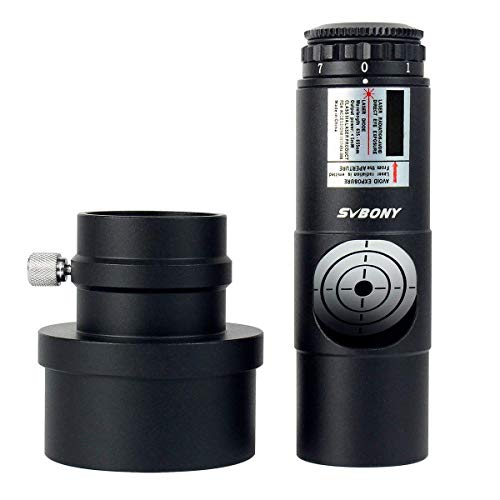 | Best Value | Collimation Type: Laser collimator | Eyepiece/Focuser Size: 1.25 inch and 2 inch | Telescope Compatibility: Newtonian reflector | CHECK ON AMAZON | Read Our Analysis |
| Astromania Laser Collimator for Newtonian Telescopes |  | Premium Pick | Collimation Type: Laser collimator | Eyepiece/Focuser Size: 1.25 inch and 2 inch | Telescope Compatibility: Newtonian reflector | CHECK ON AMAZON | Read Our Analysis |
| SVBONY SV197 Collimating Cheshire Eyepiece 1.25 Inch |  | Best For Beginners | Collimation Type: Cheshire eyepiece | Eyepiece/Focuser Size: 1.25 inch | Telescope Compatibility: Newtonian and SCT reflector | CHECK ON AMAZON | Read Our Analysis |
| Celestron 94182 Cheshire 1.25 inch Collimation Eyepiece Black |  | Budget-Friendly Choice | Collimation Type: Cheshire eyepiece | Eyepiece/Focuser Size: 1.25 inch | Telescope Compatibility: Newtonian reflector | CHECK ON AMAZON | Read Our Analysis |
| Alstar Red Laser Collimator for Newtonian Telescopes |  | Best For Professionals | Collimation Type: Laser collimator | Eyepiece/Focuser Size: 1.25 inch | Telescope Compatibility: Newtonian reflector | CHECK ON AMAZON | Read Our Analysis |
| OCAL PRO V4.0 Electronic Collimator for Telescopes |  | Most Advanced Technology | Collimation Type: Electronic collimator | Eyepiece/Focuser Size: Multiple telescope types | Telescope Compatibility: RC, Newtonian, Schmidt Cassegrain | CHECK ON AMAZON | Read Our Analysis |
More Details on Our Top Picks
Astromania Laser Collimator for Newtonian Telescopes
Why settle for a collimation tool that doesn’t match your telescope’s setup? The Astromania Laser Collimator delivers precise optical alignment for your Newtonian reflector. You’ll appreciate its premium aluminum construction with anodized finishing, ensuring durability through years of stargazing. The red laser features seven brightness levels and Class 3R safety compliance, protecting your eyes while you work. It comes fully adjusted yet allows fine-tuning through three 120° adjustment openings. With a CR2032 battery included and compatibility with all 1.25-inch focusers, you’re getting professional-grade collimation without hassle.
- Collimation Type:Laser collimator
- Eyepiece/Focuser Size:1.25 inch
- Telescope Compatibility:Newtonian reflector
- Construction Material:Anodized aluminum
- Power Source:CR2032 lithium battery (included)
- Adjustment/Brightness Levels:7 red laser brightness levels
- Additional Feature:Red laser beam collimation
- Additional Feature:Class 3R laser safety compliant
- Additional Feature:Fully pre-adjusted on delivery
SVBONY Red Laser Collimator for Newtonian Telescope
If you’re looking for rapid, reliable collimation without tedious manual adjustments, the SVBONY Red Laser Collimator delivers precise optical alignment in minutes. You’ll appreciate its solid metal construction with triple cemented lens technology, ensuring stable performance across viewing sessions. The adjustable 7-brightness settings let you work comfortably in any lighting condition, from daylight to nighttime stargazing. Its included 2-inch adapter accommodates both 1.25-inch and 2-inch reflector telescopes, maximizing versatility. Simply align by watching the red laser beam from your mirror end while adjusting collimation screws—no frustrating back-and-forth iterations required. Step-by-step instructions streamline the entire process, making this tool accessible for both beginners and experienced observers.
- Collimation Type:Laser collimator
- Eyepiece/Focuser Size:1.25 inch and 2 inch
- Telescope Compatibility:Newtonian reflector
- Construction Material:Metal with triple cemented lens
- Power Source:Not specified
- Adjustment/Brightness Levels:7 red laser brightness levels
- Additional Feature:2-inch adapter included
- Additional Feature:Triple cemented lens stability
- Additional Feature:Suitable as gift option
Astromania Laser Collimator for Newtonian Telescopes
When you’re tired of struggling with traditional collimation methods, the Astromania Laser Collimator delivers swift, precise alignment that a single person can complete without assistance. This red laser tool features seven brightness levels and a 635-655 nm wavelength, ensuring visibility in various lighting conditions. You’ll appreciate the side window with a 45° disk view that aids optimal adjustment, while the front emission port projects a collimation beam you can easily align. The metal construction houses a CR2032 battery, and it fits both 1.25″ and 2″ focusers. Three adjustment openings spaced 120° apart let you fine-tune your Newtonian telescope’s mirrors until the reflected laser beam returns to itself—your confirmation of perfect alignment.
- Collimation Type:Laser collimator
- Eyepiece/Focuser Size:1.25 inch and 2 inch
- Telescope Compatibility:Newtonian reflector
- Construction Material:Metal with 45° disk view window
- Power Source:CR2032 lithium battery (included)
- Adjustment/Brightness Levels:7 red laser brightness levels
- Additional Feature:Side window 45° disk view
- Additional Feature:Three 120° adjustment openings
- Additional Feature:Laser reflects back on itself
SVBONY SV197 Collimating Cheshire Eyepiece 1.25 Inch
The SVBONY SV197 stands out as an excellent choice for anyone seeking straightforward, battery-free collimation without breaking the bank. This 1.25-inch Cheshire eyepiece features precision-machined aluminum construction with fine crosshairs and a bright sighting mirror. You’ll appreciate the peephole top design, which gives you direct visibility of your calibration results, making alignment intuitive and accurate. The tool works seamlessly with Newtonian and SCT reflector telescopes, and you can even use it for refractor optics alignment. Since it requires no batteries, you’ll never face power limitations during daytime or nighttime observing sessions, making this a dependable addition to your collimation toolkit.
- Collimation Type:Cheshire eyepiece
- Eyepiece/Focuser Size:1.25 inch
- Telescope Compatibility:Newtonian and SCT reflector
- Construction Material:Precision-machined aluminum
- Power Source:No battery required
- Adjustment/Brightness Levels:Fixed crosshairs and mirror
- Additional Feature:No batteries required
- Additional Feature:Fine crosshairs bright mirror
- Additional Feature:Peephole top direct visibility
Celestron 94182 Cheshire 1.25 inch Collimation Eyepiece Black
Looking to achieve precise optical alignment without the guesswork? The Celestron 94182 Cheshire 1.25 inch Collimation Eyepiece delivers exactly that. This collimation tool fits seamlessly into 1.25-inch focusers and diagonals, making it compatible with most Newtonian telescopes. You’ll appreciate how it provides more accurate results than standard collimation tools, eliminating frustrating trial-and-error sessions. The Cheshire design simplifies alignment procedures, allowing you to achieve optimal optical performance quickly. Whether you’re a seasoned amateur or improving your telescope maintenance skills, this Celestron model offers the precision and reliability you need for professional-grade collimation work.
- Collimation Type:Cheshire eyepiece
- Eyepiece/Focuser Size:1.25 inch
- Telescope Compatibility:Newtonian reflector
- Construction Material:Metal
- Power Source:Not specified
- Adjustment/Brightness Levels:Fixed design
- Additional Feature:More accurate than alternatives
- Additional Feature:Easy alignment process
- Additional Feature:Fits focusers or diagonals
Alstar Red Laser Collimator for Newtonian Telescopes
Are you tired of struggling through multi-person collimation procedures? The Alstar Red Laser Collimator enables one-person operation, streamlining your alignment process for Newtonian reflectors. This next-generation laser emits a 635–655 nm red beam with adjustable brightness across seven levels, allowing you to verify reflections through its side viewing window. The metal construction houses three adjustment openings at 120-degree intervals, while the included tool fits 1.25 inch focusers. Powered by a CR2032 lithium battery, this fully adjusted collimator comes ready to use, with bilingual instructions guiding your setup.
- Collimation Type:Laser collimator
- Eyepiece/Focuser Size:1.25 inch
- Telescope Compatibility:Newtonian reflector
- Construction Material:Metal
- Power Source:CR2032 lithium battery (not included)
- Adjustment/Brightness Levels:7 red laser brightness levels
- Additional Feature:Side viewing window included
- Additional Feature:45-degree disk central hole
- Additional Feature:Adjustment tool included
OCAL PRO V4.0 Electronic Collimator for Telescopes
If you’re collimating Newtonian or Schmidt Cassegrain telescopes in the field without lugging around a laptop, OCAL PRO V4.0 delivers smartphone-based precision that rivals desktop solutions. You’ll appreciate its 0.08 mm axial alignment accuracy and intuitive four-step collimation process. The built-in calibration circles guide your adjustments visually, cutting setup time significantly. Its aluminum alloy construction supports both manual and automatic focusing at 2448P resolution. You can share collimation results instantly via screenshots for technical support or documentation. Weighing just 300 grams, it’s genuinely portable. At 16+, it’s accessible to serious amateur astronomers and professionals alike who demand reliable optical alignment without complexity.
- Collimation Type:Electronic collimator
- Eyepiece/Focuser Size:Multiple telescope types
- Telescope Compatibility:RC, Newtonian, Schmidt Cassegrain
- Construction Material:Aluminum alloy
- Power Source:5V AC power
- Adjustment/Brightness Levels:Smartphone app with calibration circles
- Additional Feature:Smartphone app interface compatibility
- Additional Feature:0.08 mm axial alignment accuracy
- Additional Feature:Built-in calibration circles visual guidance
Factors to Consider When Choosing a Telescope Collimation Tool for Perfect Optical Alignment
You’ll want to evaluate whether a collimation tool works with your specific telescope type and whether you prefer a laser or eyepiece-based design for your observing style. Your choice should balance accuracy levels against how quickly you can set up and use the tool without complications. Finally, you’ll need to assess the durability and build quality to guarantee/assure your investment withstands regular use and delivers consistent results over time.
Compatibility With Telescope Type
Because collimation tools vary considerably in their optical design and mechanical interfaces, selecting one that matches your telescope’s configuration is essential for achieving proper alignment. Newtonian reflectors require different collimation approaches than RC or Schmidt-Cassegrain telescopes, so you’ll need to verify compatibility before purchasing. You should confirm your focuser’s adapter size—either 1.25″ or 2″—since most collimation tools connect through these standard interfaces. Cheshire eyepieces work well for Newtonian secondary mirror alignment and occasionally assist refractor collimation, but they won’t suit all telescope types. Many manufacturers provide adapters to bridge different interface sizes, allowing you to upgrade or adapt tools across multiple setups. Always check product specifications against your specific telescope model to ensure proper fit and functionality.
Laser Versus Eyepiece Design
When choosing between laser and eyepiece collimation tools, you’re fundamentally deciding between speed and simplicity. Laser collimators offer you direct beam alignment with adjustable brightness levels and red wavelengths (635–655 nm), enabling quick, repeatable adjustments you’ll complete faster than traditional methods. They’re ideal for single-person operation and come with multiple adapter sizes.
Eyepiece collimators, however, require no batteries and rely on visual cues through a peephole to interpret crosshairs and mirror positions. You’ll find them excellent for daytime use with straightforward internal reference checks.
Choose lasers when you prioritize efficiency and convenience. Select eyepiece designs when you want inspection-based verification and don’t mind the slower, more deliberate alignment process. Your observing style ultimately determines which approach suits you best.
Accuracy And Precision Levels
How critical is alignment precision to your observing goals? You’ll find that accuracy depends heavily on axial alignment precision, with premium tools reporting tolerances as fine as 0.08 mm. Construction quality matters significantly—metal bodies and stable lens elements ensure consistent performance. Look for collimators offering adjustable brightness levels and measurement scales, which enhance repeatability under varying light conditions. Professional-grade options provide pixel-level alignment accuracy through integrated calibration references or app-based guidance. Don’t overlook secure adjustment mechanisms, such as 120° aperture adjustments, which maintain precision once you’ve set your alignment. Finally, always verify your collimation by observing reflected laser returns or confirming crosshair alignment. These verification steps confirm you’ve achieved the stated precision your telescope demands.
Ease Of Use And Setup
While precision metrics tell you what your collimation tool can achieve, the real-world value depends on how easily you can actually use it. You’ll benefit from quick setup and single-person operation that eliminates tedious back-and-forth adjustments. Front-emission optics and side viewing windows let you verify alignment without requiring additional equipment or assistance.
Look for adjustable brightness levels—typically seven settings—that enhance visibility across different lighting conditions, accelerating your accuracy. Pre-adjusted units with optional fine-tuning and accessible rear screw caps streamline initial setup significantly. Clear instructions in multiple languages reduce confusion and minimize setup errors.
These practical features transform collimation from a frustrating chore into a straightforward process you’ll confidently repeat whenever needed.
Durability And Build Quality
Why does a collimation tool’s construction matter as much as its optical precision? You’re investing in long-term reliability and consistent performance. A solid metal body or reinforced housing resists impacts while maintaining alignment accuracy over time. Look for sealed adjustment mechanisms with small screws that reduce dust ingress and prevent drift during extended use.
Precision-machined adjustment ports arranged at equal angles (typically 120°) ensure stable, repeatable alignment. If you’re choosing a battery-powered laser model, verify it uses reliable, long-lasting cells like CR2032 with secure compartments preventing intermittent power loss. Durable optics with multi-coated lenses and clear sighting interfaces—whether side windows or peepholes—enhance longevity and consistent performance throughout your observing seasons.
Frequently Asked Questions
How Often Should I Collimate My Telescope for Optimal Performance?
You should collimate your telescope monthly or whenever you notice performance decline. If you transport it frequently, collimate before each observing session. Regular checks maintain optimal image quality and ensure you’re getting the best views possible.
Can Collimation Tools Damage My Telescope’s Mirrors or Optics?
You won’t damage your mirrors or optics if you’re careful and use proper technique. You’ll avoid contact with reflective surfaces, follow manufacturer guidelines, and handle tools gently. You’ll protect your investment by being patient and methodical during collimation.
What’s the Difference Between Laser and Non-Laser Collimation Methods?
You’ll find laser collimators project a beam onto your mirrors, giving you instant visual feedback. Non-laser methods like Cheshire eyepieces and autocollimation caps require you to look through them manually for alignment checks.
Is Collimation Necessary for Refractor Telescopes or Just Reflectors?
You’ll need collimation primarily for reflectors since their mirrors shift out of alignment. Refractors rarely require collimation because their lenses are permanently fixed during manufacturing, making them inherently stable optical systems.
How Do I Know if My Telescope Is Properly Collimated?
You’ll know your telescope’s properly collimated when you see a centered, concentric diffraction pattern through a Cheshire eyepiece or laser collimator. You can also observe sharp star images during night-sky viewing without coma or asymmetrical halos.